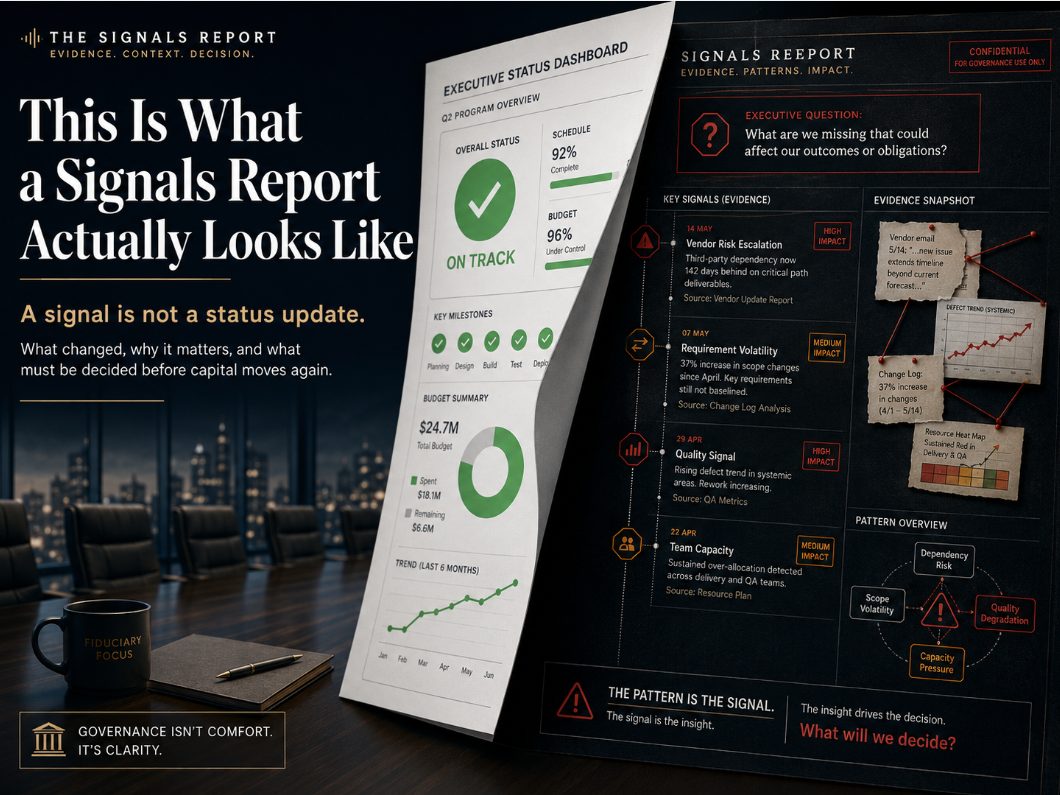
I have spent a great deal of time explaining why a signal is not a status update. A status report describes the project’s current account of itself. A signal identifies a relationship in the evidence that may change the meaning of that account. The distinction matters because a project can remain green, stay within forecast, and continue producing visible activity even after the evidence supporting routine continuation has begun to weaken.
That argument is important, but at some point the concept has to become a work product.
Executives should be able to see what a Signals Report would actually contain, how it differs from the status package they already receive, and how it improves a decision without pretending to make the decision for them. The report must be brief enough to reach the executive table, disciplined enough to preserve the evidence relationship, and restrained enough to leave judgment with the people who hold the authority.
What follows is a fictional composite built to demonstrate that operating model. It is not a description of a specific organization, client, vendor, or project. The example shows two connected views: a portfolio signal view that routes executive attention, and a project-level Signals Report that explains one material condition before the next commitment becomes difficult to reverse.
The Portfolio View: Where Does Executive Attention Belong?
Assume an enterprise investment committee is overseeing eighteen active technology investments with total authorized capital of $74.6 million.
During the current review period, fifteen investments contain delivery risks, dependencies, financial movements, and ordinary execution friction, but no validated evidence relationship has been elevated for focused executive examination. Those projects remain inside normal governance. This does not certify that they are risk-free or prove that every element of their status narrative is correct. It means that the current evidence has not shown a material change to the assumptions supporting routine continuation.
Three investments require a different level of attention.
The first is an enterprise privileged-access modernization program approaching a $1.2 million vendor extension and the retirement of its legacy platform. The current reporting measure shows strong migration progress, while the technical acceptance record shows that operational control coverage has advanced more slowly.
The second is a customer data platform approaching a $450,000 software renewal. The business objective remains valid, but the data-ingestion capability required to realize that objective has not yet produced the agreed acceptance evidence.
The third is a distribution automation program approaching production deployment. The solution can operate, but several temporary manual workarounds may become part of the permanent control environment if deployment proceeds without an explicit decision.
The portfolio view does not attempt to summarize all eighteen projects. It performs a narrower function: it tells leadership where ordinary governance remains sufficient and where a material evidence relationship must be examined before the enterprise crosses its next decision boundary.
The detailed Signals Report is produced only for the projects requiring that examination.
Example Executive Signals Report
Enterprise Privileged Access Modernization
Report date: July 15, 2026
Executive sponsor: Chief Information Security Officer
Decision authority: Enterprise Investment Committee
Technical acceptance authority: Director of Identity and Access Management
Current governance posture: Focused executive examination required
Next material commitment: Authorization of a $1.2 million vendor extension and retirement of the legacy privileged-access platform
Last reversible commercial date: August 14, 2026
Planned production transition: September 1, 2026
The Decision Before Leadership
Leadership is being asked to authorize the vendor extension and approve retirement of the existing privileged-access platform.
Those actions have been presented as parts of the same transition decision, but they do not carry the same consequence. The vendor extension may preserve the specialist capacity required to complete the modernization. Retiring the legacy platform removes part of the enterprise’s current fallback and recovery path, making the operating decision more difficult to reverse.
The question is not whether privileged-access modernization remains strategically important. The approved objective—to reduce privileged-access exposure and replace an aging platform—remains valid.
The question is whether the current implementation has produced enough accepted evidence to support the approaching transition under the conditions that exist now.
What Materially Changed?
At the April investment review, leadership approved continued implementation subject to two conditions before retirement of the legacy environment.
First, at least 90 percent of Tier 0 and Tier 1 privileged accounts would operate through enforced session controls. Second, emergency-access and recovery procedures would complete two successful production-equivalent test cycles.
The June executive packet describes privileged-account migration as 91 percent complete and maintains the September transition date. That statement is supported by the migration inventory, which shows that 91 percent of identified credentials have been discovered or placed in the new vault.
The technical acceptance record measures something different. It shows that 62 percent of Tier 0 and Tier 1 accounts currently operate through the required session-management controls. Five emergency-access and recovery tests have been completed, but only two met the agreed operating conditions.
The April approval conditions do not appear in the June executive packet.
The material change is therefore not simply that work remains. The material change is that the measure being used to describe executive readiness has separated from the measure leadership previously established for technical acceptance.
The Investment Assumptions Under Pressure
The evidence places three assumptions supporting the approved investment under pressure.
The first concerns technical readiness. The transition plan assumed that privileged credentials, sessions, emergency access, and recovery processes would operate through the new environment before the legacy platform was retired.
The second concerns risk reduction. The investment thesis assumed that moving privileged accounts would reduce exposure. Credential discovery and vaulting create meaningful progress, but they do not produce the full control outcome expected from enforced session management.
The third concerns reversibility. The operating plan assumed that the legacy environment could be retired after the acceptance conditions were satisfied. Once that environment is decommissioned and its support model is reduced, returning to the current recovery posture becomes slower, more expensive, and operationally harder.
The evidence does not establish that these assumptions have failed. It indicates that leadership should examine them directly before the next commitment is allowed to proceed as routine continuation.
The Correlated Signal
No individual fact proves that the program should pause, that the target architecture is invalid, or that the modernization has failed.
The signal appears in the relationship among several facts.
Executive reporting describes migration as 91 percent complete by counting discovered or vaulted credentials. Technical acceptance requires enforced session management, which currently covers 62 percent of the critical account population. Three of five recent emergency-access and recovery tests did not satisfy the agreed conditions. Two remediation actions were administratively closed when plans were approved, although the associated controls are not yet operational. The prior steering conditions requiring session-control coverage and successful recovery tests have disappeared from the current packet. Program spend remains within the authorized forecast, but another $1.2 million commitment is approaching. The September transition date remains unchanged even though the acceptance evidence has not advanced at the same rate as the reported migration percentage.
Together, those conditions may change what “91 percent complete and on track for transition” means at the executive table.
The program has made substantial progress. The signal is not that the work has stopped. The signal is that administrative and migration progress are being interpreted as operational readiness before the governed acceptance record supports that conclusion.
The Four Realities
The financial reality remains orderly. The program has consumed $6.9 million of its $8.6 million authorization and remains within the approved forecast. The requested vendor extension can be funded within the existing capital envelope.
The narrative reality remains confident. The executive package states that privileged-account migration is 91 percent complete and that the September transition remains on track.
The execution reality is more qualified. Sixty-two percent of the Tier 0 and Tier 1 account population operates through enforced session controls. Two of five recovery tests have met the agreed conditions, and final technical acceptance has not been issued.
The behavioral reality shows how the meaning of progress has changed. Completion has gradually shifted from operational control to credential migration. Remediation actions have closed when plans were accepted rather than when the controls became operational. The prior executive conditions are no longer visible in the current steering materials.
None of these realities is automatically false. They are measuring different parts of the program. The governance weakness is that leadership receives them separately and is therefore likely to rely on the most favorable measure when authorizing the next commitment.
The Signals Report brings the realities together without assuming which one should prevail.
Evidence Supporting Routine Continuation
A credible Signals Report must preserve the evidence supporting the current path, not merely the evidence that complicates it.
The strategic requirement to replace the legacy platform remains valid. Most identified privileged credentials have been discovered and moved into the new vault. The remaining account exceptions have assigned owners and active remediation plans. No critical security incident has occurred during the controlled pilot period. The vendor has retained specialists who understand the implementation. The technical team believes the remaining session-control coverage can be completed without redesigning the target architecture. Finance confirms that expenditure remains within the authorized forecast.
That evidence may support continued investment. It may also support retaining the vendor team so the enterprise does not lose the capacity required to finish the work.
It does not automatically support retiring the legacy environment on the current date.
Evidence Complicating Routine Continuation
Thirty-eight percent of the Tier 0 and Tier 1 account population remains outside the agreed session-control requirement. Three recent recovery tests did not satisfy the approved operating conditions. The technical authority responsible for acceptance has not approved retirement of the legacy environment. Several hundred service and application accounts continue to depend on exception procedures. The prior proof requirements are absent from the current executive packet. Proceeding with legacy retirement would reduce the enterprise’s fallback options before the remaining acceptance evidence is complete.
This evidence does not dictate the decision. It changes the basis on which the decision should be made.
What Remains Uncertain?
The current record does not establish whether the remaining account population can reach the required session-control coverage before September 1. It does not establish whether the unsuccessful recovery tests reflect temporary configuration defects or a more persistent operating limitation. It does not establish whether a temporary dual-operation period would materially reduce transition risk. It does not establish whether the enterprise can preserve the vendor resources while delaying legacy retirement for a bounded period. It also does not establish whether the original 90 percent threshold remains the appropriate acceptance condition under the current account population.
Those questions require technical, financial, commercial, and executive judgment. They cannot be resolved by a status color or by an analytical system turning incomplete evidence into artificial certainty.
Why the Signal Matters Now
The decision window is closing because the commercial commitment and the operating commitment are being treated as one action.
Authorizing the vendor extension may protect the investment by retaining scarce implementation knowledge and preserving completion capacity. Delaying that extension could increase execution risk if the enterprise loses the people most capable of resolving the remaining conditions.
Retiring the legacy platform creates a different form of exposure. It reduces reversibility by removing an established fallback path before the new environment has produced all of the evidence leadership previously required.
The Signals Report therefore reveals an option that the ordinary status discussion may not surface: approve the vendor extension while conditioning legacy retirement on accepted session-control and recovery evidence.
That is not necessarily the correct answer. Leadership may conclude that the current evidence supports both commitments, neither commitment, or a different bounded posture. The report does not select the outcome. It prevents two materially different decisions from passing through governance as one routine continuation action.
The Executive Questions
The first question is:
What current evidence supports retiring the legacy privileged-access environment on September 1 when only 62 percent of the critical account population operates through the required session controls, two of five recovery tests have met the approved conditions, and final technical acceptance remains open?
The related commercial question is:
Can leadership authorize the vendor extension to preserve implementation capacity while conditioning legacy retirement on accepted evidence that the remaining session-control and recovery requirements have been satisfied?
These questions are specific enough to prevent the signal from disappearing into another general discussion about confidence, recovery, or whether the project remains green. They are also open enough to preserve several legitimate answers.
Continuation can still be the decision. It simply has to become an explicit, evidence-based decision.
The Next Proof Condition
Before legacy retirement is authorized, leadership may require verified session-control coverage against the agreed Tier 0 and Tier 1 account population, two consecutive successful emergency-access and recovery tests under production-equivalent conditions, disposition of the remaining service-account exceptions, confirmation that monitoring and support procedures are operational, and formal acceptance from the accountable technical authority.
If leadership determines that the original conditions are no longer appropriate, those conditions should be revised through an authorized decision rather than allowed to disappear from the reporting process.
Decision Ownership and Report Boundary
The Chief Information Security Officer remains accountable for the business and risk objective. The Identity and Access Management authority determines whether the technical acceptance evidence is sufficient. Finance provides the current capital position. Procurement and vendor management interpret the commercial options. The enterprise investment committee decides whether to continue, condition, constrain, recover, renegotiate, revalidate, pause, or stop the applicable commitment.
The Signals Report does not inherit any of those authorities merely because it makes the relationship visible.
It does not declare a cybersecurity incident, establish a control deficiency, make an accounting or procurement conclusion, accuse the program team or vendor of misconduct, activate a Capital Risk Trigger automatically, or decide whether the program should continue.
It packages the evidence relationship for judgment. It does not own the judgment.
How the Signals Report Changes the Decision
A conventional steering discussion might begin with a reassuring summary: the program is 91 percent complete, remains within budget, and is on track for September. Leadership may ask whether the remaining accounts can be completed and whether the vendor is still confident in the date.
Those are reasonable execution questions, but they do not expose the governing condition.
The Signals Report shows that the reported progress measure is not the acceptance measure. It restores the conditions attached to the prior approval. It shows that technical proof remains incomplete, identifies the evidence that still supports the investment, preserves the uncertainty, and distinguishes the reversible vendor decision from the less reversible platform-retirement decision.
Leadership can now make a more precise decision. A defensible outcome might read as follows:
Approve the vendor extension to preserve implementation capacity. Maintain the September transition as provisional. Do not authorize retirement of the legacy environment until the technical acceptance authority confirms the agreed session-control coverage and two successful recovery tests. Return to the investment committee with the acceptance evidence or a bounded alternative transition plan before the retirement decision becomes irreversible.
That decision does not treat uncertainty as failure. It does not punish the team for exposing incomplete evidence. It does not blindly continue because the project remains green. It preserves the valid business objective while connecting the next commitment to the proof leadership requires.
This is the difference between visibility and judgment.
The status report helps the enterprise understand what the project is currently saying. The Signals Report helps leadership understand where the evidence may have changed the meaning of that statement. It compresses the material relationship without erasing source, contradiction, uncertainty, decision proximity, or the evidence supporting more than one possible conclusion.
What We Have Been Leading Toward
The Signals Report is not a standalone invention. It is the executive-facing point in a larger evidence-to-decision architecture.
The Evidence Locker preserves the governed record. The Project Brain maintains chronology, context, prior decisions, and unresolved conditions. The Refinery prepares Digital Exhaust into usable governance intelligence. The Four Realities reveal where financial, narrative, behavioral, and execution evidence no longer move together. Forensic Signals identify the few relationships that may change accountable judgment. The Fiduciary Lens interprets their capital meaning. The Capital Risk Trigger governs when routine continuation may require formal reconsideration. The Governance Shield preserves what leadership knew, what options existed, and why the decision was made.
The Signals Report carries the most material part of that architecture into the executive room.
It is deliberately small because executives cannot reconstruct the entire project record. It is deliberately traceable because a concise assertion without evidence discipline becomes another polished narrative. It is deliberately balanced because a report designed only to prove concern becomes an accusation mechanism. It is deliberately non-autonomous because source authority, materiality, professional interpretation, and investment decisions remain human responsibilities.
Most projects should not produce a detailed Signals Report during every reporting period. Most execution friction belongs inside normal management. A report should be produced when validated, correlated evidence may change the meaning of routine continuation and when an approaching commitment gives that relationship consequence.
The objective is not to create more findings, more reporting, or another portfolio bureaucracy.
The objective is to shorten the distance between changing evidence and accountable judgment while there is still time for judgment to matter.
That is what the Signals Report actually looks like.
It does not tell leadership what to think.
It shows leadership what can no longer be left unexamined before capital moves again.