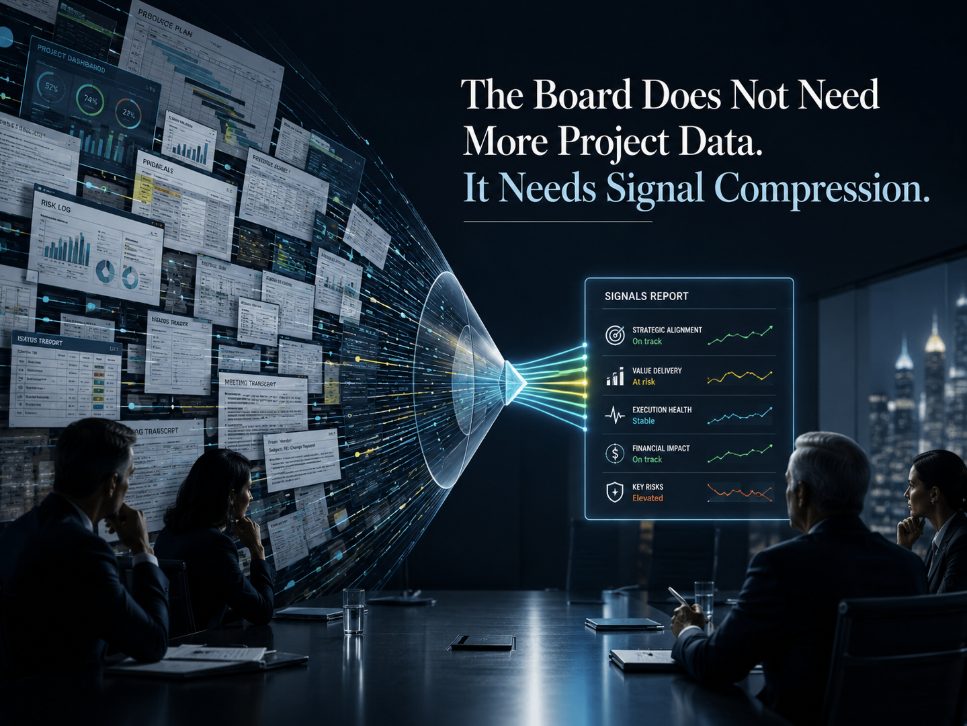
The modern enterprise has no shortage of project data. It has schedules, forecasts, risk registers, issue logs, architecture decisions, invoices, contracts, technical records, meeting transcripts, ticket histories, vendor updates, steering decks, and increasingly sophisticated dashboards. It can measure activity at a level that would have been impossible a generation ago, yet executives continue to be surprised by projects whose underlying condition had been deteriorating for months.
The problem is not simply that leadership lacks visibility. In many organizations, executives can see more project information than ever before. The deeper problem is that the evidence reaches them in one of two unusable forms.
In the first form, leadership receives too much. The project record may be complete in the broadest sense, but it is distributed across hundreds or thousands of artifacts. No CIO, CFO, CISO, board member, transformation executive, or investment committee can reconstruct every transcript, ticket comment, financial movement, vendor caveat, decision condition, and technical qualification before each governance meeting.
In the second form, leadership receives too little. The evidence has been compressed into a polished status narrative that is easy to consume but may have lost the relationships that give it meaning. A missing proof point becomes a revised date. A qualified vendor statement becomes a general expression of progress. A persistent dependency becomes one line in a risk table. A funding condition imposed during an earlier review disappears into the cadence of subsequent updates.
The packet becomes easier to read while the investment becomes harder to govern.
What the executive table needs is not more project data and not merely a better summary. It needs Signal Compression: a disciplined way to reduce volume while preserving the few evidence relationships that could change the meaning of continued investment.
Status Reporting Compresses the Story
Traditional status reporting performs a necessary function. Executives cannot govern directly from the entire operational record, so the project must be compressed into a current account of itself. The report explains what was accomplished, what comes next, which dates have moved, which risks remain open, how spending compares with forecast, what the vendor believes, and whether an executive decision is required.
A well-prepared status report may be accurate, candid, and professionally responsible. The problem is not that status reporting exists. The problem appears when the status report becomes the final object of governance.
Most status artifacts are organized around the project’s current testimony. They explain what the project team, sponsor, vendor, PMO, and supporting functions believe during the present reporting cycle. Because the initiative remains active, the report naturally favors continuity. It describes how the approved work is progressing and how known difficulties are being managed.
That orientation can remain intact even after the evidence underneath the narrative has begun to change.
A promised demonstration may gradually become a validation activity, then a technical walkthrough, and finally a future proof point. A vendor commitment may narrow into an expectation. The same dependency may survive several reporting periods under different names. A technical caveat may remain in a ticket or working-session transcript while the executive summary continues to describe progress. Spending may remain inside forecast even though the last funding period produced little accepted evidence of asset creation, risk reduction, or decision movement.
None of those facts, considered alone, proves that the project is failing. Together, however, they may change what leadership needs to examine before more capital moves.
That is the distinction between a status update and a signal.
A status update summarizes the current project story. A signal identifies a relationship in the evidence that may change the meaning of that story.
The Artifact Is Not the Signal
One of the easiest mistakes in AI-enabled governance is to label every unusual artifact as a signal. A late ticket becomes a signal. A negative sentence in a meeting transcript becomes a signal. A missed date, budget variance, open risk, or vendor qualification becomes a signal.
That approach does not create better governance. It creates a larger findings queue.
A ticket is not automatically a signal. Neither is a transcript, a financial variance, an open risk, or a delayed milestone. Each may contain useful evidence, but the signal usually emerges from the relationship among several dimensions: source, time, context, contradiction, uncertainty, persistence, and the decision now approaching.
A late date may reflect ordinary execution friction. A late date connected to repeated proof failure, narrowing vendor language, continued spending, and an unmet executive condition is materially different.
An open risk may be responsibly managed. A risk whose language softens while the underlying condition persists across several reporting cycles may deserve closer examination.
A vendor confidence statement may be sincere and reasonable. Confidence that remains stable while accepted evidence does not advance should not carry the same governance weight it carried before the evidence changed.
The executive report of the future must preserve these relationships. Otherwise, the enterprise will use AI to automate the same information loss that human reporting created manually.
Better Packaging Is Not Better Governance
Artificial intelligence will dramatically improve the mechanics of project reporting. It can review more records, compare multiple reporting periods, reconstruct chronology, identify contradictory statements, find recurring dependencies, and produce polished executive prose at a speed no traditional PMO could match.
Those capabilities are valuable, but they also create a serious risk: the enterprise may use AI to produce a cleaner version of the same incomplete status narrative.
The result will look modern. The summary will be generated in seconds. The dashboard may become conversational. Executives may ask questions in natural language. Agents may prepare weekly reports without human intervention.
None of that guarantees that the underlying evidence relationships survived the compression process.
If source, timing, context, contradiction, uncertainty, prior decision conditions, and evidence authority are removed, AI has not improved governance. It has improved packaging. It has made the current story easier to consume without establishing whether that story still matches the governed record.
A faster status report can therefore accelerate the wrong thing. It can reduce administrative effort while allowing inherited confidence to pass through the governance system with even less resistance.
The executive report of the future cannot merely summarize activity more efficiently. It must show what changed in the evidence, why that change matters to the investment, and what leadership must now examine.
Signal Compression Preserves Decision Meaning
Signal Compression is the governance discipline of reducing evidence volume while preserving the meaning required for accountable judgment.
Its purpose is not to make the project easier to present. Its purpose is to ensure that the few relationships capable of changing the next decision survive the journey from the operating record to the executive table.
At minimum, Signal Compression must preserve:
Source, so leadership knows whether a statement came from the sponsor, vendor, PMO, finance view, technical authority, delivery team, prior decision, or working conversation.
Time, because a confidence statement made before a failed proof attempt should not carry the same weight afterward.
Context, because a missed date can represent responsible validation, ordinary friction, avoidable drift, scope learning, vendor limitation, or a weakening assumption.
Contradiction, because the most important signal may exist between a stable steering narrative and a deteriorating technical record.
Uncertainty, because unknowns should not be converted into confidence merely to make the report easier to approve.
Relevance, because most project facts do not belong at the executive table.
Decision use, because a signal matters only when it affects an approaching commitment, prior condition, material assumption, or available intervention.
A shorter summary that removes these features is not Signal Compression. It is presentation compression. It may help the meeting move faster, but it may also make governance worse by producing an artifact that becomes easier to approve precisely after the evidence relationship has been weakened.
The board does not need the whole record. It also does not need a smoother version of the official story. It needs the few evidence relationships that could change accountable judgment, compressed enough to receive executive attention and preserved enough to remain governable.
The Signals Report Defined
The Signals Report is the disciplined executive-facing artifact that surfaces the most decision-relevant forensic signals from refined governance intelligence so leadership can see what requires attention before capital moves again.
In plain English:
The Signals Report shows leaders what the evidence is now signaling.
Its place in the operating system is precise.
The Evidence Locker preserves the governed record. The Project Brain maintains chronology, context, prior decisions, unresolved conditions, and evolving project state. The Refinery extracts, structures, compares, and reconciles the evidence. The Signals Report carries the few material relationships from that refined record into the place where accountable capital judgment occurs.
This makes the Signals Report a governance interface between a complex longitudinal evidence base and the leaders responsible for determining what routine continuation now means.
It does not replace the PMO’s responsibility for delivery visibility. It does not replace finance’s responsibility for the expenditure and forecast view. It does not replace the technical authority responsible for proof, the sponsor accountable for the business objective, or the distinct roles of risk, audit, procurement, legal, security, privacy, accounting, and investment governance.
Its purpose is to allow those partial views to meet on a governed decision surface.
The enterprise may have clearly assigned responsibilities while still lacking the ability to reconcile the full evidence chain across time. The PMO holds the status. Finance holds the spend. The technical team holds the acceptance condition. The sponsor holds the business objective. Risk holds the formal exposure. Audit may hold an earlier condition. The vendor holds a delivery narrative.
No individual function must be wrong for the total picture to be incomplete.
The Signals Report closes that correlation gap.
What the Report Surfaces
Consider a composite enterprise program approaching another funding or deployment decision.
The executive packet shows a revised milestone and a stable forecast. The sponsor continues to support the objective because the capability remains important. The PMO reports that validation is progressing. Finance confirms that authorized spending remains within plan. The vendor states that the team is working through the remaining technical issues.
Nothing in those statements is necessarily inaccurate.
The technical record carries another part of the condition. The promised demonstration has been narrowed into several validation activities, but accepted proof has not advanced. An earlier steering decision required that proof before a broader commitment, yet the condition no longer appears in the current packet. The related action was closed after the scheduled work was performed, although the acceptance condition remained unresolved. A risk once associated with the missing proof was later described as a dependency and eventually disappeared from the executive view.
Meanwhile, spending continued, business-readiness activity moved later, and the expected benefit window began to compress.
No individual fact settles the matter. A revised milestone may be reasonable. A stable forecast may be correct. Continued spending may be necessary to complete responsible validation. A closed action may accurately represent completed effort. A renamed risk may reflect better classification.
The signal appears in the relationship among those facts.
The narrative says the program is progressing through validation. The execution record shows that accepted proof remains static. The financial record shows continued consumption against the approved path. The behavioral record shows an earlier decision condition fading from active attention. The benefit window is narrowing while the current packet still presents continuation as ordinary.
That combination may place an important investment assumption under pressure: the assumption that the current path can still deliver the approved outcome within the required window.
The Signals Report does not declare that assumption invalid. It makes the relationship visible so leadership can determine what the evidence now requires.
Four Executive Lenses
The Signals Report can organize this relationship through four interpretive lenses: Narrative, Evidence, Spend, and Decision Signals. These are not mandatory database fields, workflow stages, ownership categories, or an exhaustive taxonomy. They are practical ways to help executives examine different dimensions of the same condition.
Narrative Signals
The narrative lens examines how the official explanation is moving over time. A demonstration becomes a validation. A commitment becomes an expectation. An unresolved condition receives a softer name. Confidence remains unchanged while the basis for confidence weakens.
Narrative movement does not establish deception. Language may change because the team has learned more, because the requirement became clearer, because the sponsor is responsibly protecting a valid objective, or because the vendor is expressing uncertainty more accurately.
The governance question is whether the current explanation still represents the condition faithfully enough to support the next decision.
Evidence Signals
The evidence lens asks whether current claims remain supported by traceable, accepted, and decision-relevant proof. It examines missing proof, moved proof, narrowed proof, stale proof, conflicting sources, unaccepted evidence, and actions that close while their acceptance conditions remain open.
A project may produce substantial activity without producing the evidence that a governing decision actually required. Tickets may close. Tests may run. Meetings may occur. Documents may be approved. None of those automatically satisfies the proof condition leadership believed it would receive.
The Evidence Signal exists in the gap between the claim and the authoritative proof.
Spend Signals
The spend lens connects consumption to what the enterprise is receiving in return. It includes money, vendor effort, internal labor, executive attention, organizational capacity, and the opportunity cost of keeping the current path active.
The relevant question is not merely whether the program remains within budget. A project can remain inside forecast while spending becomes less connected to asset creation, accepted proof, recovery, risk reduction, value realization, or meaningful decision progress.
A ledger can accurately show what was consumed. It may not show what that consumption produced.
Decision Signals
The decision lens examines whether a prior condition, required choice, funding gate, unresolved tradeoff, or available alternative is being carried forward without explicit adjudication.
A steering committee may have authorized continuation subject to accepted proof before broader deployment. Several reporting cycles later, the proof remains unresolved, but the condition no longer appears in the packet. The program continues because no one has formally changed the path.
That continuation is still a decision.
The Decision Signal restores the choice to the leaders authorized to make it. It does not tell them what answer to choose.
Correlation Before Escalation
The strongest signals often appear when several lenses converge.
Narrative language softens. Accepted proof remains static. Spending continues. A prior condition disappears. Business readiness moves later. The benefit window narrows.
Any one of those facts may be ordinary, explainable, and manageable. Together, they may change the quality of the capital judgment.
This is why the Signals Report should not become a findings dump. A correctly identified wording change, missing artifact, reopened ticket, delayed milestone, or continuing expenditure is not automatically an executive signal. Accuracy is necessary, but accuracy is not materiality.
Materiality depends on the relationship to an approved assumption, the persistence of the condition, proximity to a material decision, evidence strength, potential consequence, reversibility, and remaining intervention space.
Most execution friction should remain inside ordinary management. Teams need room to solve problems, test assumptions, recover dates, correct vendor performance, and absorb the uncertainty inherent in difficult work.
A Signals Report that elevates every variance would create more noise, more administrative burden, and more defensive reporting. It would recreate the Admin Tax under a more serious name.
The objective is not to escalate more. It is to recognize the few conditions that should not disappear inside routine continuation.
Severity Without Scoring Theater
Once organizations begin detecting signals, they will be tempted to score them. The familiar response will be a weighted model, heat map, composite index, traffic-light scale, or AI-generated risk score that appears to convert complexity into precision.
That may create the appearance of control while weakening judgment.
Signal severity is not a universal number. It is the level of attention or examination warranted by the evidence under the current circumstances.
Severity changes through relationships such as:
source quality and authority;
corroboration across independent evidence;
persistence over time;
contradiction among the Four Realities;
the investment assumption affected;
potential consequence;
proximity to a funding, contract, deployment, or other difficult-to-reverse decision;
reversibility;
remaining intervention space;
prior proof conditions;
unresolved uncertainty.
These considerations matter, but they should not be flattened into a score that pretends to carry more authority than the underlying evidence.
A signal can be accurate without being material. A signal can be material without being severe. A severe signal can still contain uncertainty. None of those distinctions can be responsibly eliminated by arithmetic alone.
The Signals Report should help leadership determine whether a condition belongs in normal governance, requires focused executive examination, or may warrant formal investment revalidation. It should not manufacture certainty through scoring theater.
The Signal Must Become an Executive Question
A Signals Report should not end with a finding. It should translate the evidence relationship into the question accountable leadership must answer.
For example:
The prior funding decision required accepted proof before broader deployment. That proof remains unresolved, the associated action has closed, spending continues, and the next commitment is approaching. What evidence or bounded condition must now be satisfied before the broader commitment proceeds?
That question is materially different from asking:
Why has the team failed to deliver?
The first preserves uncertainty, authority, and legitimate response options. The second smuggles a verdict into the question.
A well-formed executive question should carry forward:
what changed;
which assumption or prior condition is affected;
the evidence supporting the concern;
what remains uncertain;
the commitment or decision approaching;
the potential consequence;
the remaining decision window;
the function or forum authorized to decide.
The answer may still be continuation. Leadership may conclude that the business objective remains valid, the recovery path is credible, and the team deserves a bounded period to produce proof. The project may need additional time, constrained funding, a renegotiated vendor commitment, restored acceptance conditions, a revised delivery path, or no additional executive action at all.
The Signals Report prepares that judgment. It does not own it.
What the Signals Report Must Never Become
The Signals Report will fail if the institution turns it into another administrative system.
It must not become a monthly questionnaire requiring every project to re-prove its entire business case. It must not become an automated accusation engine, a high-volume findings queue, or a centralized super-PMO. It must not generate algorithmic verdicts, assign blame, or allow analysts and AI systems to claim authority that belongs to accountable executives and qualified functions.
It must also avoid becoming a new Human Middleware production line in which project teams spend more time preparing rebuttals, documenting every uncertainty, and feeding another reporting process.
That outcome would be especially damaging because excessive escalation changes behavior. Teams would learn to hide early uncertainty. Vendors would protect themselves with broader language. Sponsors would delay raising concerns until the evidence became undeniable. PMOs would sanitize the formal record. The enterprise would receive cleaner reporting and weaker truth.
Proportionality is therefore not a courtesy. It is an evidentiary control.
Most conditions should remain in normal management. Signals should be retained, merged, monitored, returned for clarification, or closed without escalation when the evidence does not warrant executive attention. A mature system is defined as much by what it does not elevate as by what it surfaces.
From Visibility to Consequence
Enterprises have spent years improving visibility through dashboards, integrations, portfolio tools, automated reporting, executive summaries, and now AI assistants. Yet visibility alone does not protect capital.
Leadership can see more and still act too late.
The missing layer is consequence. The reporting system must show not only that something changed, but why the change matters to the next governing decision. It must preserve enough evidence context for executives to determine whether the investment requires continued confidence, bounded proof, recovery conditions, commercial renegotiation, constrained commitment, pause, pivot, formal revalidation, or no additional action.
This is where the Signals Report separates itself from the traditional status artifact.
A status update tells leadership what the project is saying now. A signal shows where the refined record may be saying something different underneath it. The status report preserves cadence and shared awareness. The Signals Report protects judgment by focusing attention on the evidence relationships that could change the meaning of continuation.
The objective is not to make executives read the entire project record. It is not to create a larger deck, a more complicated dashboard, or an algorithmic score that pretends to replace human accountability.
The objective is to compress the signal without erasing the evidence relationship that makes it meaningful.
The executive report of the future will not merely explain what the project did during the last reporting period. It will show what changed in the evidence, why that change matters to the investment, and what decision leadership can no longer allow routine continuation to make by default.
Because the board does not need more project data.
It needs the evidence relationships that determine what capital should do next.